
Abstract
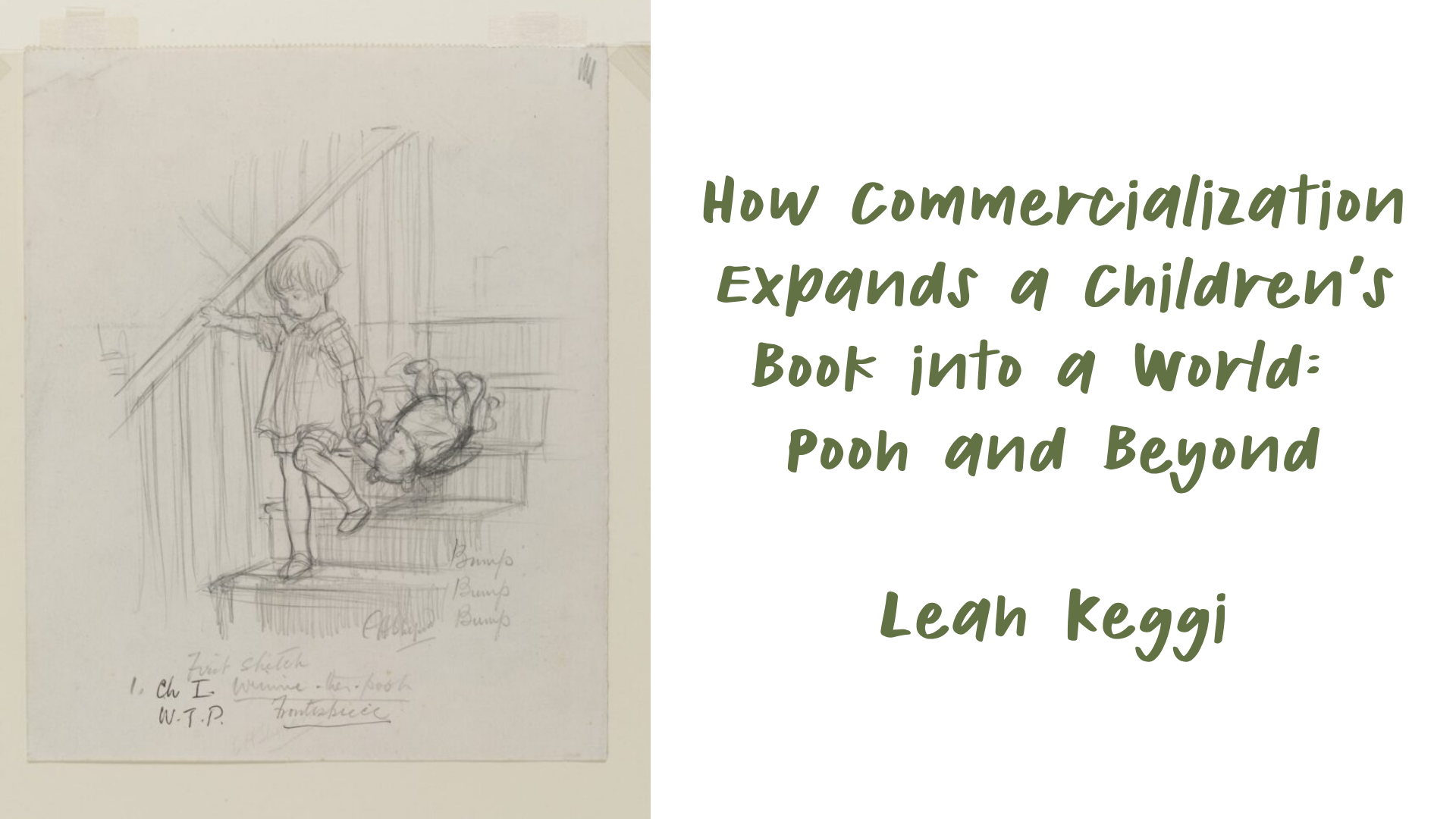
How Commercialization Expands a Children’s Book into a World: Pooh and Beyond.
While the commercialization of literary works can feel like a cash-grab in a capitalist sense, merchandise and other brand extensions can build a world that better reaches children. In this presentation, I’ll explore the expansion of merchandise and licensing in children’s literature (including Winnie the Pooh, of course) from the 1930s to present day properties. From toys to apparel, I will present that merchandise can build not just a brand but a world for children around the books. In my conclusion, I will propose ways that publishers and authors can incorporate elements into their own book launches, without a Disney budget.
Introduction
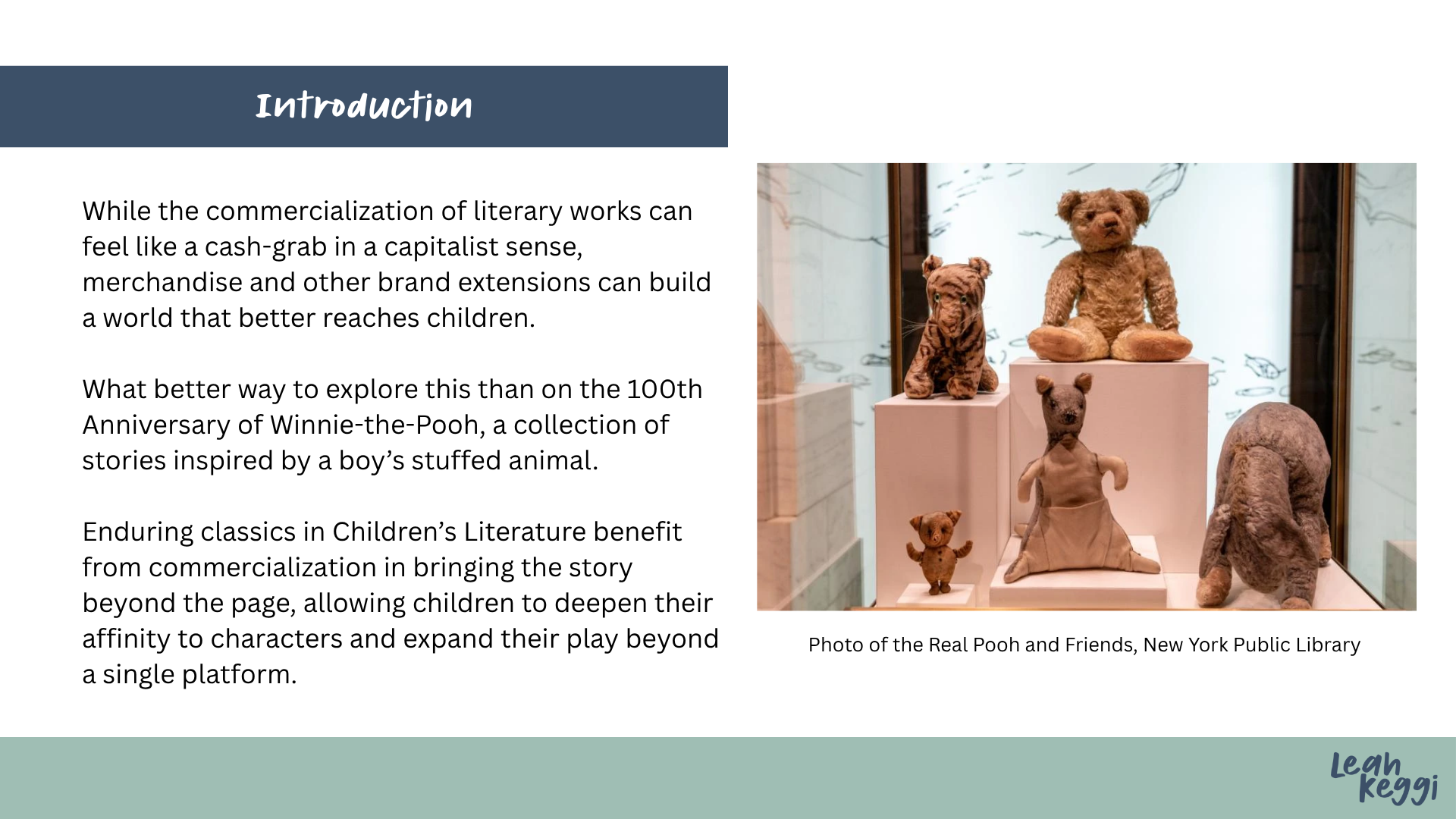
While the commercialization of literary works can feel like a cash-grab in a capitalist sense, merchandise and other brand extensions can build a world that better reaches children. What better way to explore this than on the 100th Anniversary of Winnie-the-Pooh, a collection of stories inspired by a boy’s stuffed animal. Enduring classics in Children’s Literature benefit from commercialization in bringing the story beyond the page, allowing children to deepen their affinity to characters and expand their play beyond a single platform.
History:
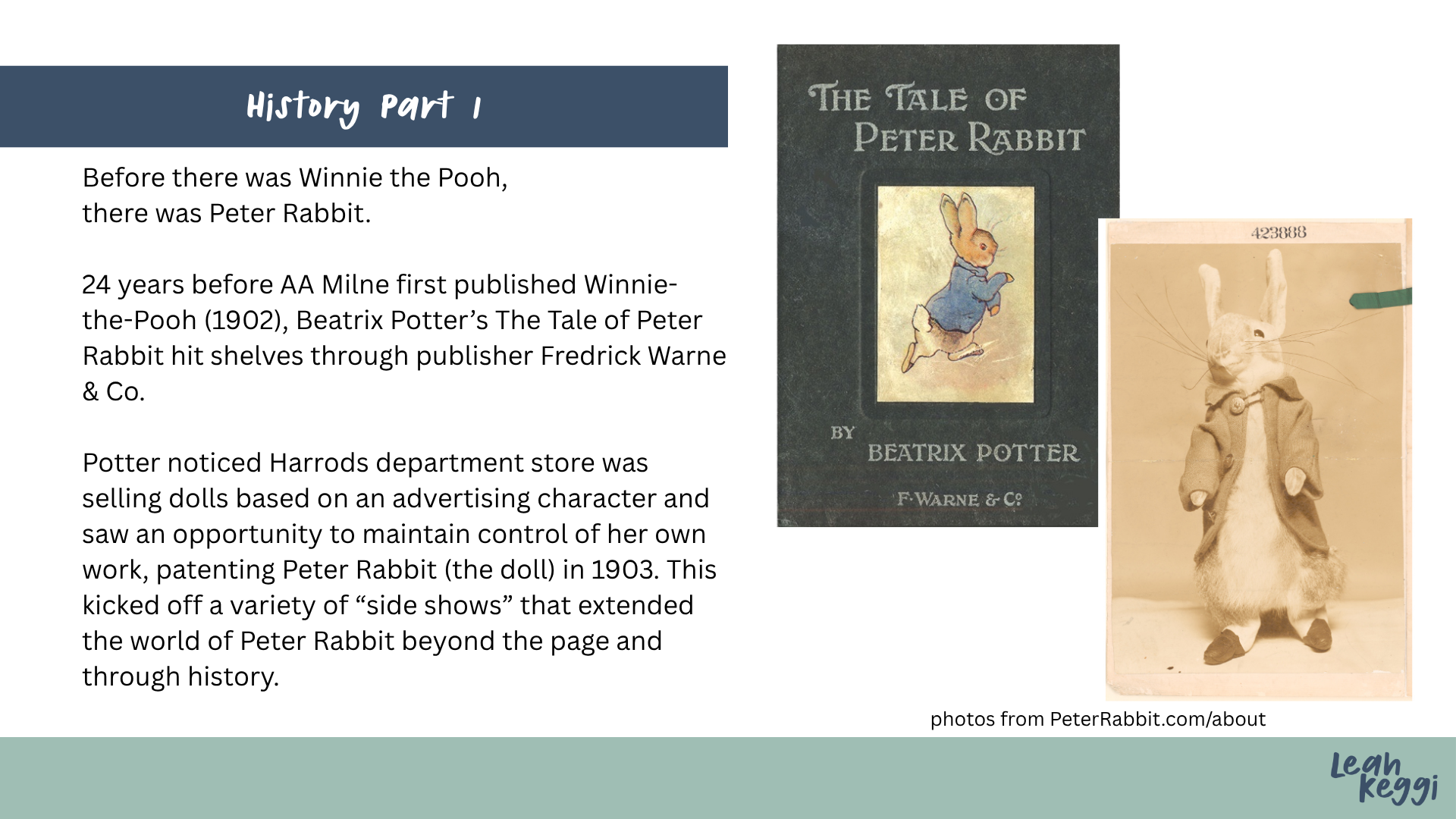
Before there was Winnie the Pooh, there was Peter Rabbit. 24 years before AA Milne first published Winnie-the-Pooh (1902), Beatrix Potter’s The Tale of Peter Rabbit hit shelves through publisher Fredrick Warne & Co.
Potter noticed Harrods department store was selling dolls based on an advertising character and saw an opportunity to maintain control of her own work, patenting Peter Rabbit (the doll) in 1903. This kicked off a variety of “side shows” that extended the world of Peter Rabbit beyond the page and through history.
Potter took these projects on herself, reluctantly dragging her publisher along. Originally, Warne & Co didn’t understand the value of Potter’s side-shows, but was convinced after the initial success of Potter’s own actions.
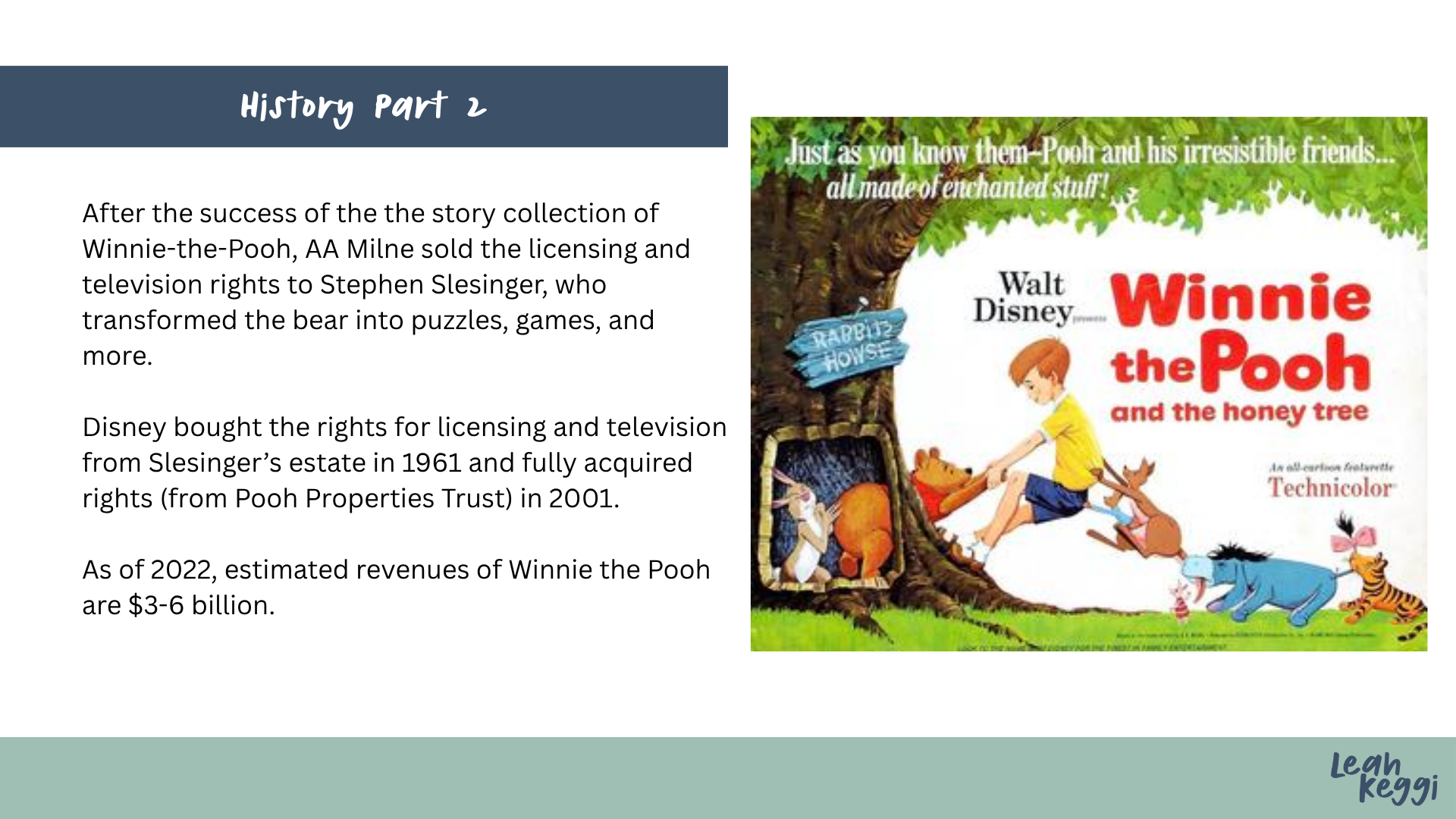
After the success of the the story collection of Winnie-the-Pooh, AA Milne sold the licensing and television rights to Stephen Slesinger, who transformed the bear into puzzles, games, and more.
Disney bought the rights for licensing and television from Slesinger’s estate in 1961 and fully acquired rights (from Pooh Properties Trust) in 2001.
As of 2022, estimated revenues of Winnie the Pooh are $3-6 billion.
For the sake of time, we’ll gloss over lawsuits related to rights in the later years, but it’s a cautionary tale of ensuring that everyone in the process (authors, illustrators, and publishers) are clear and upfront about opportunities and rights.
While Winne-the-Pooh was successful in it’s own right as a book, the reinforcement of character through merchandise helped propel the value of the franchise as a whole.
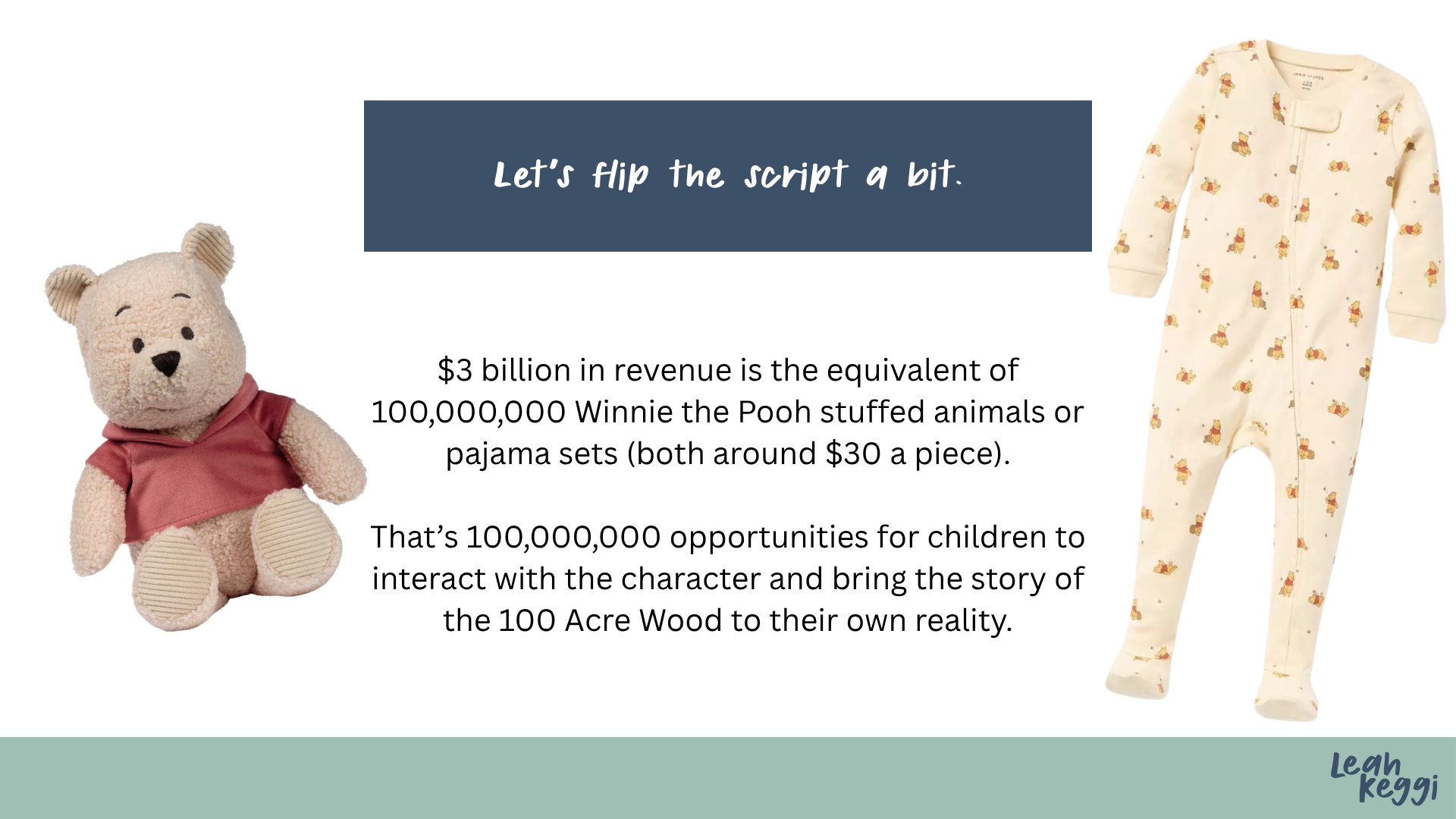
Let’s flip the script a bit. Rather than look at dollars, think about it in terms of items that children engage with.
$3 billion in revenue is the equivalent of 100,000,000 Winnie the Pooh stuffed animals or pajama sets (both around $30 a piece).
That’s 100,000,000 opportunities for children to interact with the character and bring the story of the 100 Acre Wood to their own reality.
The Hypothesis:
Licensed merchandise and commercialization of children’s literary characters brings forward the opportunity for enhanced play and development.
This is in opposition to views like Daniel D Hade’s Publication: Curious George Gets Branded, Reading as Consuming.
Hade, Daniel D. “Curious George Gets Branded: Reading as Consuming.” Theory Into Practice 40, no. 3 (2001): 158–65. http://www.jstor.org/stable/1477471.
Rather than take an cynical or anti-capitalist view of children’s book merchandising and commercialization, I see it as an opportunity to expound and expand upon the underlying message of the story.
The Research
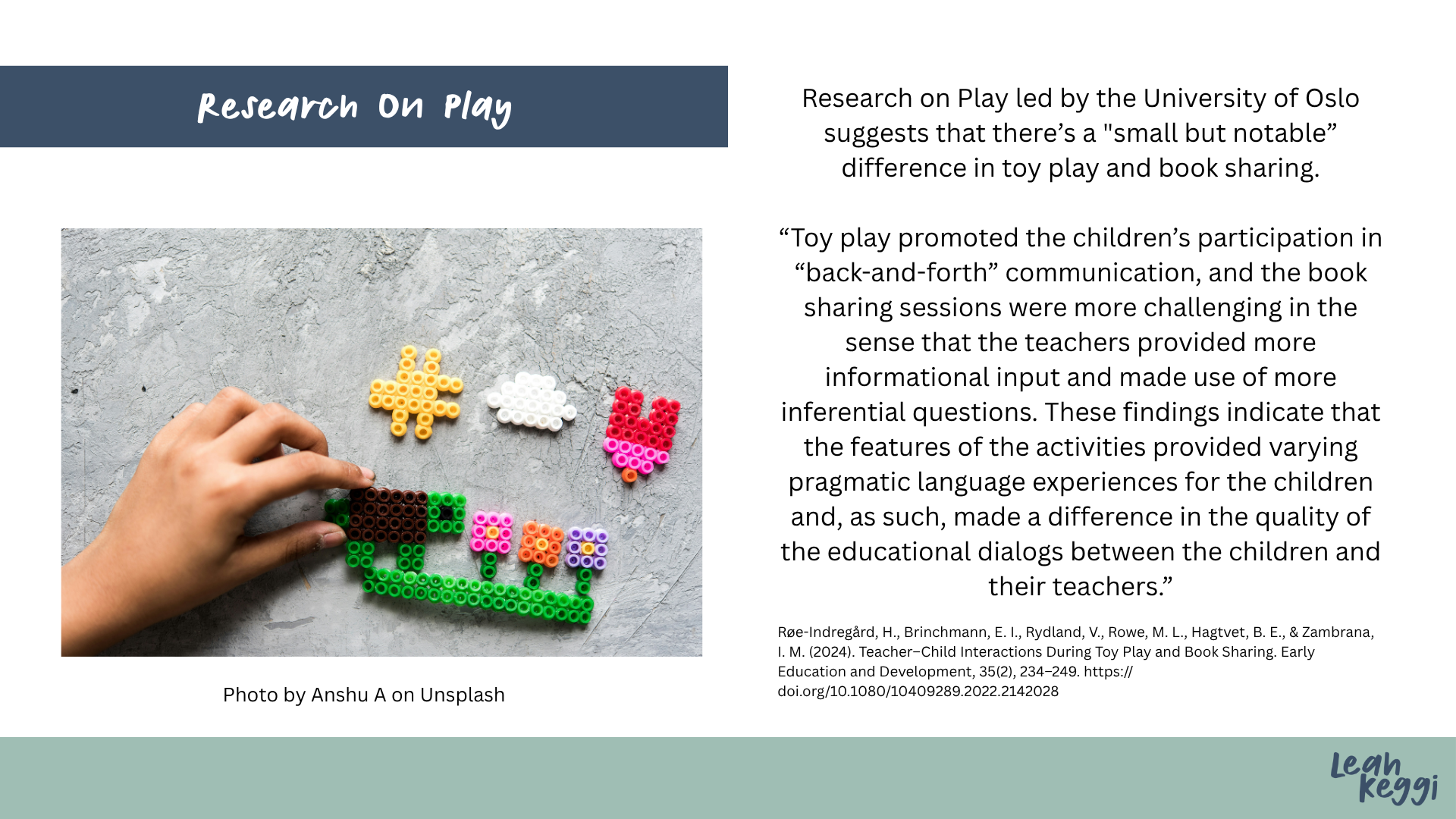
Research on Play led by the University of Oslo suggest that there’s a "small but notable” difference in toy play and book sharing.
“Toy play promoted the children’s participation in “back-and-forth” communication, and the book sharing sessions were more challenging in the sense that the teachers provided more informational input and made use of more inferential questions. These findings indicate that the features of the activities provided varying pragmatic language experiences for the children and, as such, made a difference in the quality of the educational dialogs between the children and their teachers.”
Bringing more informational input into “back-and-forth” communication through merchandise that connects toy play and book sharing can further advance development and reinforce learning.
Other research, as documented in a chapter of Learning by Playing: “Cross-Platform Learning: How Do Children Learn from Multiple Media?” reinforces this finding. Link: https://academic.oup.com/book/1862/chapter-abstract/141598681?redirectedFrom=fulltext
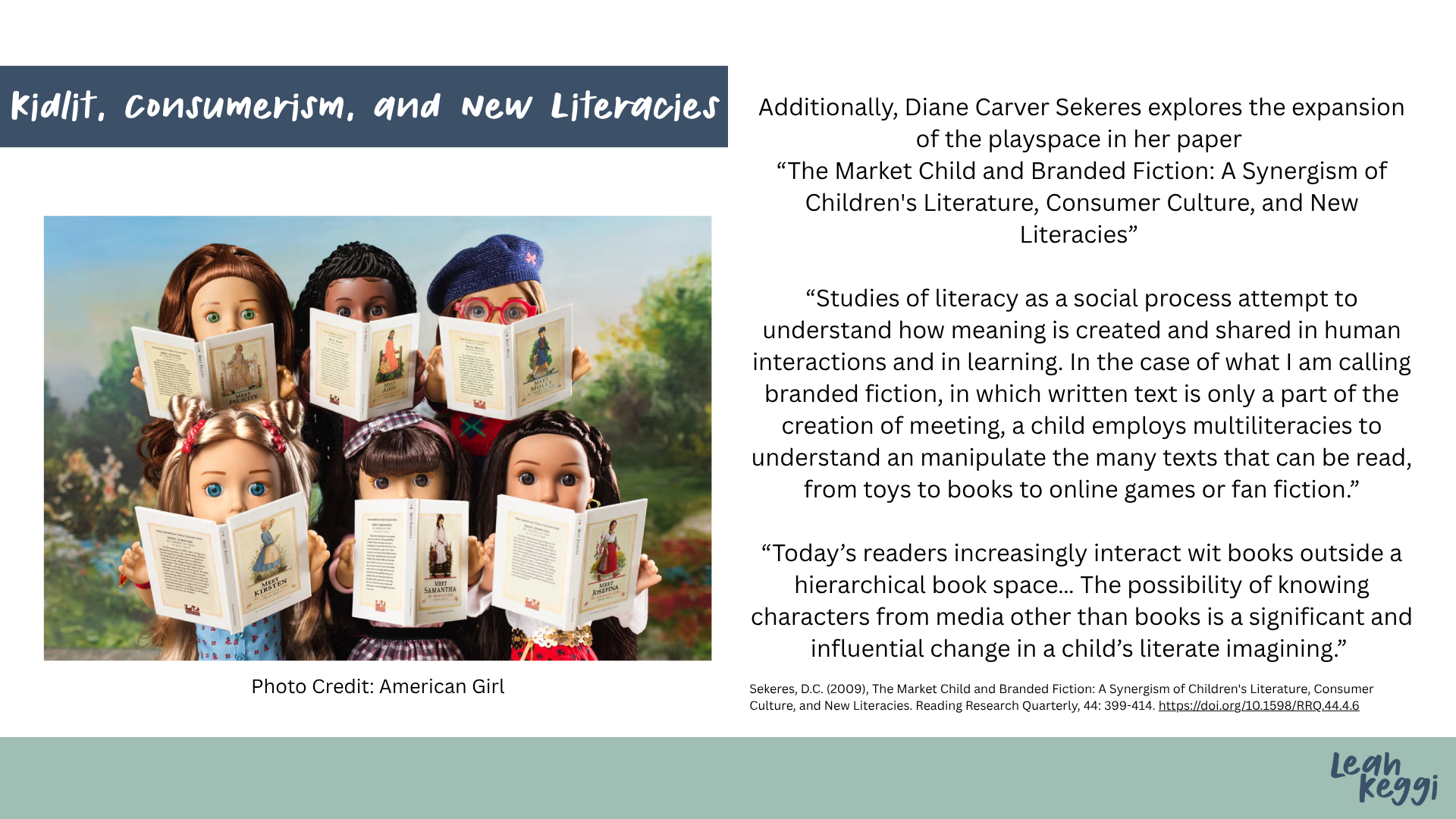
Additionally, Diane Carver Sekeres explores the expansion of the playspace in her paper
“The Market Child and Branded Fiction: A Synergism of Children's Literature, Consumer Culture, and New Literacies”
“Studies of literacy as a social process attempt to understand how meaning is created and shared in human interactions and in learning. In the case of what I am calling branded fiction, in which written text is only a part of the creation of meeting, a child employs multiliteracies to understand an manipulate the many texts that can be read, from toys to books to online games or fan fiction.”
“Today’s readers increasingly interact with books outside a hierarchical book space… The possibility of knowing characters from media other than books is a significant and influential change in a child’s literate imagining.”
Sekeres paper focuses on the idea of branded fiction, where the character exists before the written material, like American Girl and Hannah Montana. Which, to some extent, mirrors how many children interact with Winnie the Pooh today.
Expanding the idea of the playspace to incorporate the free play or expansion of storylines that merchandise can bring to literature (and vis-versa) helps give a more rounded look at the way children interact with the work, and with books.
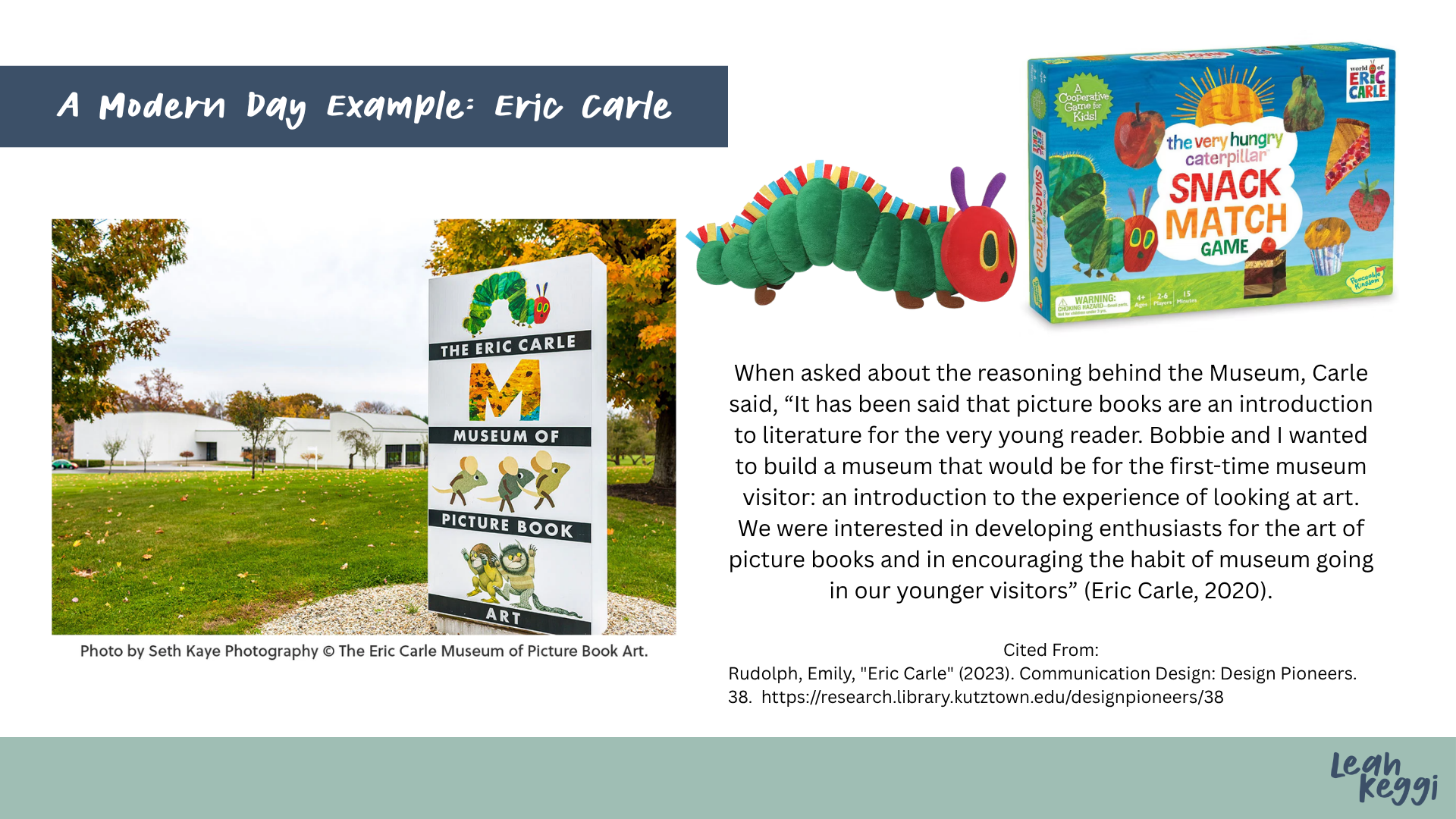
Example of Commercialization Today: Eric Carle
“When asked about the reasoning behind the Museum, Carle said, “It has been said that picture books are an introduction to literature for the very young reader. Bobbie and I wanted to build a museum that would be for the first-time museum visitor: an introduction to the experience of looking at art. We were interested in developing enthusiasts for the art of picture books and in encouraging the habit of museum going in our younger visitors” (Eric Carle, 2020).”
Rudolph, Emily, "Eric Carle" (2023). Communication Design: Design Pioneers. 38.
https://research.library.kutztown.edu/designpioneers/38
I use the example of Eric Carle, as well as this quote, to demonstrate the more optimistic view of merchandise and commercialization. The Carle Museum exists not as a shrine, but as a way to expand the familiar character into new experiences for good.
How to Expand Your Book’s World
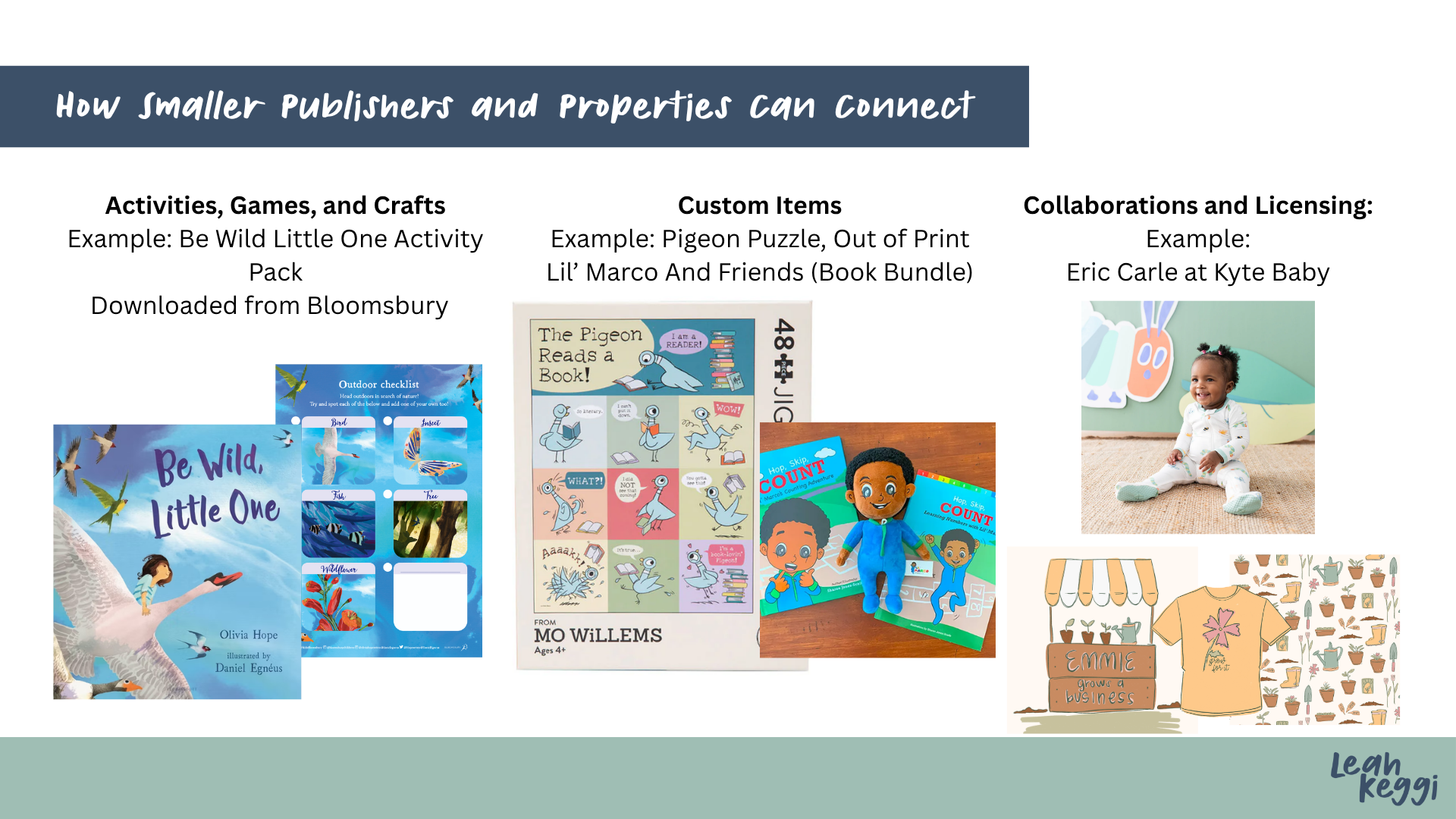
Activities, Games, and Crafts:
Downloadable, Printable Activities and Coloring Sheets can be a great way to provide support to educators that may be interested in showcasing a book, but can also provide additional emphasis on characters and messages that turn a book from a once-in-a-while read to a favorite story recommended to friends.
These are best for picture books and early readers, where patents may be more involved in filling a child’s time, but can be applied across children’s literature.
This can take the form of a secondary product (like a coloring book), printable downloads, or collaboration with game-makers.
Custom Items:
Similar to the first patented Peter Rabbit doll, Authors, Illustrators and Publishers can collaborate on custom items and make them available for sale, whether it’s just around launching the book or as a chance to create “new news” around an existing work.
In 2026, the opportunity for Print-on-Demand merchandise also provides a low barrier to entry for merchandise like art prints or children’s apparel.
Collaborations and Licensing:
While currently mostly leveraged by major publishers and large franchises, I see an opportunity for publishers, illustrators, and authors to create secondary art inspired by the content of picture books that can be applied to collaboration projects with small to medium sized businesses, like children’s apparel and toy companies for a mutually beneficial marketing promotion that also adds revenue for both businesses.
As an example, in my experience as a marketer and surface pattern designer, I mocked up ideas based on a manuscript I’m currently querying to agents. Emmie Grows a Business is about a girl who turns a love of dirt into a business and prints featuring garden tools, flowers, and spouts would pair nicely with apparel and accessories (if you’re curious about Emmie, you can read my current query letter below).
Much of the strategy I share in my book The Merch Blueprint* can be applied in this context.
Additionally, you can read my query letter for Emmie Grows a Business here:
Sources and Links:
ACADEMIC PAPERS
Hade, Daniel D. “Curious George Gets Branded: Reading as Consuming.” Theory Into Practice 40, no. 3 (2001): 158–65. http://www.jstor.org/stable/1477471.
Røe-Indregård, H., Brinchmann, E. I., Rydland, V., Rowe, M. L., Hagtvet, B. E., & Zambrana, I. M. (2024). Teacher–Child Interactions During Toy Play and Book Sharing. Early Education and Development, 35(2), 234–249. https://doi.org/10.1080/10409289.2022.2142028
Fisch, Shalom M., and others, 'Cross-Platform Learning: How Do Children Learn from Multiple Media?', in Fran C. Blumberg (ed.), Learning by Playing: Video Gaming in Education (New York, 2014; online edn, Oxford Academic, 24 Mar. 2015), https://doi.org/10.1093/acprof:osobl/9780199896646.003.0014
Sekeres, D.C. (2009), The Market Child and Branded Fiction: A Synergism of Children's Literature, Consumer Culture, and New Literacies. Reading Research Quarterly, 44: 399-414. https://doi.org/10.1598/RRQ.44.4.6
Rudolph, Emily, "Eric Carle" (2023). Communication Design: Design Pioneers. 38. https://research.library.kutztown.edu/designpioneers/38
ARTICLES:
https://peterrabbit.com/about/
https://www.smithsonianmag.com/arts-culture/winnie-pooh-became-household-bear-180967090/
https://www.thedisneyclassics.com/blog/winnie-the-pooh
https://www.nypl.org/about/locations/schwarzman/childrens-center-42nd-street/pooh
BOOKS AND MERCHANDISE:
TBD